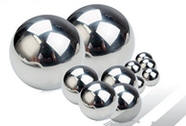
Stainless steel ball is a spherical metal
product made of stainless steel material, widely used in industrial
manufacturing, mechanical transmission, surface treatment and other fields. It
has excellent corrosion resistance, wear resistance, and strength, and can
maintain stable performance in harsh environments such as humidity, acid and
alkali, and is not easy to rust.
Main materials and classification.
Stainless steel balls can be divided into multiple series according to their
materials, and common models include:
201 stainless steel ball: Low cost, with certain rust prevention ability,
suitable for ordinary hardware accessories, home appliances and other fields.
304 stainless steel ball: Austenitic stainless steel, non-magnetic or weakly
magnetic, with strong rust resistance, is the most widely used type, commonly
used in medical devices, food machinery, valves, electronic components and other
scenarios with high hygiene requirements.
316/316L stainless steel ball: Adding molybdenum element on the basis of 304
significantly improves the resistance to chloride corrosion, especially suitable
for seawater equipment, chemical, pharmaceutical and medical implant components,
and has passed FDA certification and can be used for medical grade products.
420 stainless steel ball: martensitic steel with magnetism and high hardness
(HRC50-55), used for components such as pulleys, bearings, valves, etc. that
require wear resistance.
440C stainless steel ball: with the highest hardness (HRC ≥ 58), strong wear and
corrosion resistance, close to the level of bearing steel balls, commonly used
in high-precision instruments, aerospace, seals and other high-end fields.
Give maximum hardness with good corrosion resistance to fresh water, steam, crude oil, and gasoline, perspiration, alcohol, and blood and food environment.